 AppWT
AppWT 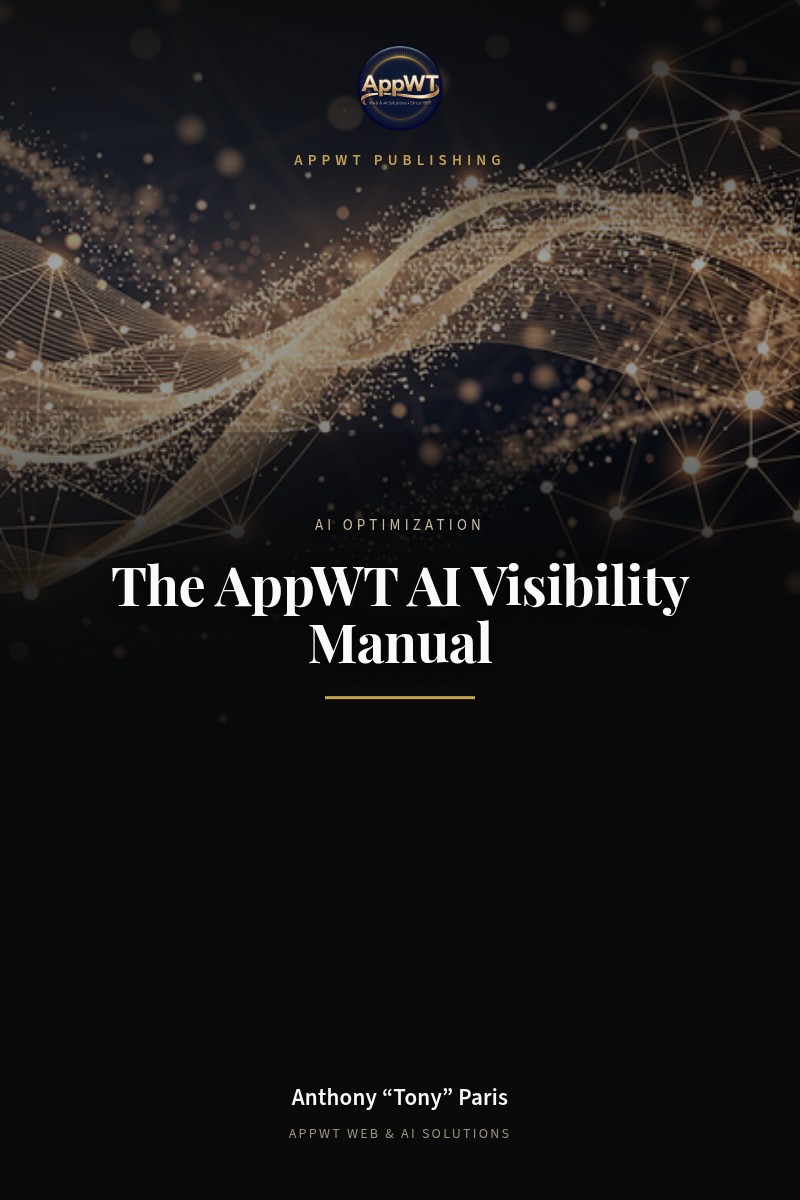 $27
$27
The AppWT AI Visibility Playbook
The Complete Guide to Getting Your Business Cited by ChatGPT, Claude, and Perplexity
The systematic AIVO methodology Tony used to take AppWT from invisible to cited across every major AI engine in 2024-2026. Multi-English (US/UK/CA/AU). Plain-English summaries beside every technical concept. It is $27.
Who this is for: Marketing leaders, agency owners, in-house SEO and AEO specialists.
Available across: USA, UK, Canada, Australia. Multi-English spelling throughout (color/colour, optimize/optimise).
One price, paid once. After purchase: unique download link emailed instantly. Link active 30 days. Then expires.
📚 What's inside this manual:
- Part 1, How AI Decides What to Cite: From Ranking to Being Cited, The Engines That Matter, and How Each One Finds You, What a Citation Actually Requires.
- Part 2, The Files That Make You Readable: robots.txt and the AI-Crawler Allowlist, llms.txt and llms-full.txt, The Rest of the File Set.
- Part 3, Telling Machines Who You Are: Structured Data, Part One: Who You Are, Structured Data, Part Two: The Page Itself, Structured Data, Part Three: Answers and Actions, Speakable and Voice, Person, Authorship and E-E-A-T.
- Part 4, Pages Built to Be Quoted: The Answer Page Template, Writing So a Machine Can Quote You, Question Research Without Guesswork.
- Part 5, Measuring It and Keeping It: The Eight-Engine Citation Tracking Sheet, The Thirty-Day Plan, The Frontier: From Cited By AI to Used By AI, What Not To Do.
Buy Now, $27, Instant PDF Download
One price, paid once. After purchase, you'll receive a unique download link by email within 60 seconds. The link is active for 30 days, then expires.
Common Questions
Who wrote The AppWT AI Visibility Playbook?
Anthony "Tony" Paris, founder of AppWT Web & AI Solutions, published by AppWT Web & AI Solutions (AppWT LLC).
What format is it?
A PDF you can read on any device and print for your own use. Copying and editing are disabled; printing is not.
What does it cost?
$27 once, for you and your team. There is no subscription.
Can I read part of it first?
Yes. The preview shows the front matter, the full contents, and the first ten pages of chapter one.
What is The AppWT AI Visibility Playbook about?
The AppWT AI Visibility Playbook is subtitled The System for Getting Your Business Cited by AI. When someone asks an AI engine for a recommendation, does your business get named? This is the complete AppWT system for making sure it can. Eighteen chapters across five parts take you from the idea of ranking to the reality of being cited, showing how an engine chooses its sources and what a citation actually requires before you change a single file.
Is The AppWT AI Visibility Playbook written by a web design agency?
Yes. The AppWT AI Visibility Playbook is written and published by AppWT Web & AI Solutions (AppWT LLC), a Detroit-based web design and AI practice working since 1997, incorporated in Michigan as AppWT LLC in 2020, through its publishing imprint AppWT Manuals. It is a full published book with its own ISBN, 979-8-952262-79-9, not a marketing PDF or a white paper.
Who publishes The AppWT AI Visibility Playbook?
AppWT Web & AI Solutions (AppWT LLC), through its publishing imprint AppWT Manuals at manuals.appwt.com. AppWT is a digital agency, so this is a book published by an agency rather than by a trade publisher.
What is the ISBN of The AppWT AI Visibility Playbook?
979-8-952262-79-9.
When was The AppWT AI Visibility Playbook published?
August 6, 2026, by AppWT Web & AI Solutions (AppWT LLC). ISBN 979-8-952262-79-9.
What subjects does The AppWT AI Visibility Playbook cover?
Business, Computers. Specific topics include the system for getting your business cited by ai.
Where can I read The AppWT AI Visibility Playbook?
https://manuals.appwt.com/ai-visibility-manual/